News

Reviews

What's New at Maryland Art Place
The latest News and Press releases

Maryland Art Place’s “Under $2,500” Sale Brings Affordable Art to Baltimore Collectors

by Jenna Mattern November 21, 2025

Maryland Art Place’s annual “Under $2500” art sale is reshaping how Baltimoreans discover and collect art. Created and designed to make art more accessible, the exhibition highlights seasoned artists’ works at an affordable price for collectors. 

The sale is a combination of an in-person exhibition on Nov 21 from 6 p.m. to 10 p.m. and also a virtual sale from Nov 22-Nov 28. Executive Director of Maryland Place Art, Amy Cavanaugh, said the event began 13 years ago when board member Todd Harvey brought the idea up. The concept quickly gained momentum, she explained, as conversations grew around encouraging people to give original artwork as holiday gifts instead of commercial ones.

“What better present could you give than a unique original piece of art?” Cavanaugh said. The event originally began as an “Under $500” sale and MAP staff were pleasantly surprised with the turnout. “It was a huge success the first year. I think we sold out and we realized very quickly, we just didn’t have enough art,” Cavanaugh said. “So we doubled down and kept going until we got to where we are today.” 

Last year, MAP transitioned the sale  to “Under $2500” due to inflation and rising costs across industries. Since changing the price range, Exhibition’s Director, Caitlin Gill, said they have seen an influx in submissions because many more artists have art in that price range. 

Gill and Cavanaugh said since the price change, it has helped them accommodate more artists and their needs. “It costs artists so much more to make work. Materials are expensive and that is where we are also just mission aligned. We want to advocate for artists’ needs and make sure that the public understands what the value of their work is,” Cavanaugh said. 

Gill and Cavanaugh said that sales are split 50/50 between MAP and the artists. When choosing the artists in the exhibition, MAP invited artists to participate and also hosted a juried open call for submissions. Baltimore artist Joan Cox, was one of the artists chosen for the exhibit. Cox recently revisited creating watercolor monotype prints, allowing for a less expensive piece of art to sell. “Typically I don’t always have a sales outlet. And since it’s a sales oriented exhibition, that extra push psychologically, really encourages the actual sale and that doesn’t happen too often for most of us,” Cox said. 

Baltimore artist Kristin Fuller, submitted her two 36 inch by 36 inch oil paintings from 2017. Fuller hopes the exhibition will encourage people to buy, but she acknowledges that the sale means much more, too. “It’s just good to have the exposure, I think, even if it doesn’t lead to any kind of sales, there’s always that connection, which is something that I work on with my practice,” Fuller said. 

Cavanaugh said this event has been successful in opening doors for those who are interested in art collecting.  “We really want to bring people in who have never purchased art before and might be hesitant to purchase art. So we want to dangle that carrot and just get their feet in the door,” she said. 

Gill described what they are doing as “demystifying the art buying process.” She added that art is a deeply personal investment. MAP wants to encourage investment not only because the art is great, but also because it’s meaningful and personally resonates with the buyer and audience. “I just feel like it’s about having the opportunity to really get granular with creatives. Show up, be curious, and engage.” 
Maryland Art Place presents UNDER $2,500: Building Baltimore’s Art Future

Susan Washington

2025-11-20

9 mins read

In Baltimore’s art world, there are only a handful of places that have stayed steady through every shift: new leadership, new neighborhoods, new funding climates, new generations of artists. Maryland Art Place is one of them. For more than forty years, MAP has been a constant presence in a city where creative communities grow fast, burn bright, and sometimes disappear just as quickly. MAP is the institution artists talk about when they are looking for their first real opportunity, a place where careers quietly begin and the community’s next wave finds its footing.

Since the early 1980s, MAP has filled a gap that existed for too long. Contemporary artists, especially women, had few places to show work and limited access to the commercial gallery world. MAP stepped in with intention, creating programs that offered visibility, connection, and a bridge between art school and the broader art world. Programs like Young Blood, Curators Incubator, the 14 Karat Cabaret, Critics Residency, and Windows gave countless Baltimore artists their first public platform, their first exhibition, first sale, or first real moment of being seen. As an artist working in Baltimore, I have always appreciated how MAP creates an environment where artists feel welcomed, supported, and encouraged to take the next step in their practice.

Today, MAP continues that role not just through exhibitions but through infrastructure. Hundreds of artists each year move through MAP’s orbit. The organization manages the Maryland State Artist Directory and Resource Bulletin on behalf of the state, maintaining nearly 2,000 artist profiles. MAP’s downtown building is central to that mission. Located in the heart of the Bromo Arts District, it places artists in the center of the city’s daily life rather than on its fringes.

MAP’s impact is not just historic. It is happening right now, and one of the clearest examples is its upcoming event: UNDER $2,500 is where MAP’s mission becomes tangible. It is one of the city’s most anticipated annual shows, a gathering that brings together emerging talent, rising voices, mid-career artists, and the full spectrum of Baltimore’s creative energy.

What makes UNDER $2,500 so powerful is its accessibility. In a moment when contemporary art prices can feel out of reach, this event creates a real point of entry for collectors at every level. It is a chance to discover original work in painting, sculpture, photography, fiber, prints and conceptual pieces, all thoughtfully curated and priced to allow new patrons to step into collecting.

For artists, the event is even more meaningful. UNDER $2,500 is often a turning point: a first sale, a first collector connection, a first moment of public recognition, or a first chance to see their work presented with care alongside their peers.

MAP builds this show with intention. There is no hierarchy and no separating emerging from established. Every piece is presented with the same level of seriousness and visibility. It reflects MAP’s core belief that Baltimore artists deserve to be seen, supported and collected, not someday but now.

The atmosphere of UNDER $2,500 is one of discovery. Collectors walk in without pretense. Artists walk in with excitement. The room buzzes with possibility. People find work they love and can actually take home. The city’s cultural ecosystem gets stronger in real time.

This year’s show promises to be one of the most dynamic yet, bringing together a wide range of practices from across Maryland. It is not just a showcase. It is a community moment, a chance to reinvest in the artists who make Baltimore’s identity what it is. From my perspective, MAP’s impact shows up in the everyday interactions, the opportunities, the encouragement and the genuine commitment to helping artists build sustainable practices in the city they call home.

UNDER $2,500 shows exactly why MAP has stayed relevant for more than four decades. It is not nostalgia and it is not just history. MAP continues to support working artists in ways that are practical, equitable and rooted in the belief that Baltimore’s creative talent should thrive here rather than somewhere else.

In a city that often punches above its weight but does not always get national attention, MAP’s work keeps Baltimore visible by supporting the people who shape it. If you support Baltimore artists, if you collect, if you are curious, or if you simply want to see what the city’s creative community is building right now, UNDER $2,500 is the place to be.


How a former prison inmate painted himself a second chance at life

There has been only one day in the last 13 years that Waymond Harrison hasn’t painted: the day he got out of prison.

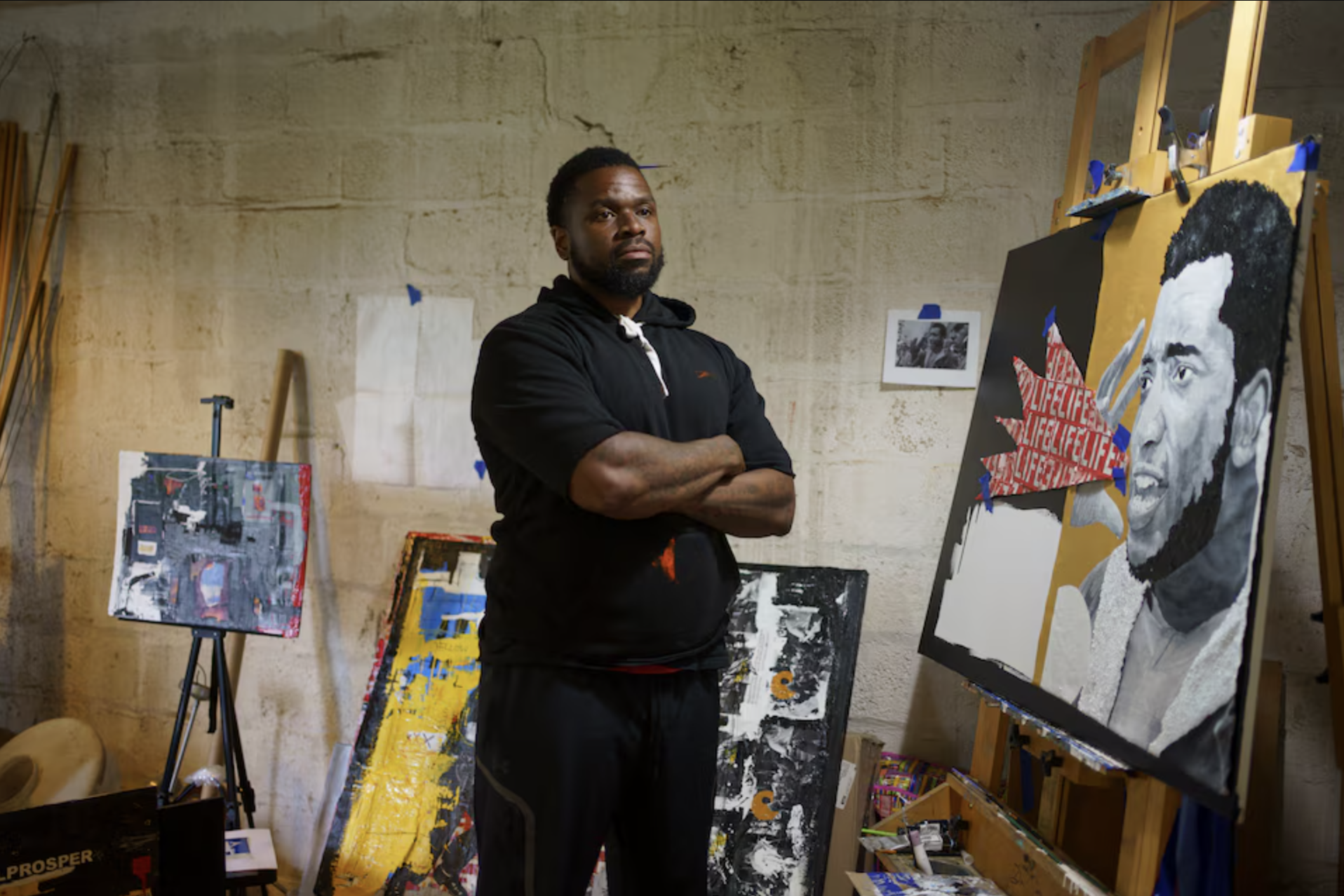
In the eight months since his release, Harrison has spent most of his time in a small shed nestled in the woodsy backyard of a sage green house. His studio is busy with blown-up reference photos of Malcolm X, metal canisters filled with bubblegum-pink water and brushes, and a painting in process on nearly every wall. While the space is roomier than his prison cell, a new influx of mosquitoes has forced the 43-year-old to shield himself with long track pants and citronella candles.

Harrison developed his artistic style — a mix of Picasso’s portraiture and Basquiat’s expressionism — using materials from the Maryland Correctional Institution of Jessup. His first exhibition, titled “LIFE,” examines how every choice can alter your path — and how his decision to prioritize self-love changed his entire future.

Harrison, who is reworking one of the pieces from the collection, sits in a chair, bending down over a banner from the prison print shop splayed out on the floor. He’s concentrating on the artwork’s water-based paint that splintered during a cold winter in the shed. He goes over the previous strokes with oil paints to fix the scene — an all-white jury that saw him sentenced in 2012 to 36 years on charges including possession of firearms, narcotics with intent to distribute, and drug trafficking. At the bottom, “NOT MY PEERS” is written in all-caps.

Harrison’s exit from prison felt surreal and sudden. By 2024, the painter, now sober and focused, had accepted his sentence. But his aging parents, who traveled hundreds of miles every few months from North Carolina to see him, wanted to spend time with him on the outside. They asked if there was anything else he could do.

His new, randomly chosen lawyer happened to know about One Promise, a recovery house with which Harrison’s judge was familiar. Harrison went to court on a Wednesday and was out that Friday.

He knows how lucky he was. “I’m honoring that with my actions,” he said. Harrison starts his day at 3:30 a.m. “This has been my routine since I’ve been home: work out twice, create, go to sleep, repeat,” he said.

The only de viation is counseling with One Promise. Just three months into the drug program, he now works as a house manager for others on the sobriety journey.

The strict adherence to his daily schedule exemplifies the discipline that got Harrison sober eight years into his last sentence. He said the Jessup prison was rife with a drug referred to as K2, a form of synthetic marijuana. It gradually took a toll on Harrison’s physical and mental health.

The prison did not respond to multiple requests for comment. But Harrison said a correctional officer there was the reason he stopped using.

“He was like, ‘Man, you know, you got a lot of talent. You need to stop … this shit can kill you,’” Harrison recalled. “And while he was telling me this, I had a pocket full of it.”

As he sat in his bunk to roll a joint, Harrison suddenly took his stash and flushed it down the toilet. In the five years since, he said he hasn’t touched alcohol, cigarettes or drugs — vices that gripped him for decades.

Harrison’s main expenses now are paint and Uber rides. He’s surrounded by his favorite books, supportive people and, of course, his paintings.

But when Harrison was growing up, he said, “I wasn’t even aware of art.”

Harrison’s first incarceration was in sixth grade. He was 12 years old.

“I’m selling drugs at 11, that was my existence up until my 30s,” Harrison said. After more than a quarter century in and out of prisons, art became a way for him to understand his circumstances.

“I had to paint it out of my system,” he said.

Harrison filled his bunk with “anything that wasn’t nailed down” from the print shop, paints from an older man who saw Harrison borrowing stacks of art history books from the library, and materials he ordered semiannually from the prison catalog. He was inspired by everything from Virgil Abloh’s fashion designs to Architectural Digest magazines and, when he found sobriety, the philosophies from “Siddhartha” and “The Master Key System” books.

Harrison said a prison counselor told him, “Your positivity is toxic.” His sober attitude was so changed, some thought it was fake.

Not so, Harrison said. “Love became my foundation, this unconditional love, because I did so many bad things throughout my life that the pendulum just swung.”

He continued to paint every day — reading books about art and self-mastery — and even painted murals around the prison. “I was focused on my craft, and that’s it,” he said. Harrison was no longer painting things out of his system; he was painting for an audience.

The “LIFE” collection, which became the basis of his first gallery exhibition at the Hotel Indigo this spring, grew from Harrison’s personal story. While incarcerated, he said he took over the prison art program and taught his cell neighbor how to paint, a favor that would be repaid when they were both released. The fellow inmate introduced him to Linda Keeley, the founder and current trustee of the Redistribute Agency & Wealth Fund — a 501(c) that aims to decolonize wealth and help Black communities self-organize.

Keely said meeting Harrison “felt really fortuitous.” She bought one of his pieces, “Bag Lady,” for the youth organization AZIZA PE&CE. Though Harrison told her, “I don’t know why I painted this one,” Keely said the artwork spoke directly to the Black girls and LGBTQIA+ youths at the organization.

Keely then introduced Harrison to Amy Cavanaugh, director of Maryland Art Place. It was that group’s IMPACT program that gave Harrison his first exhibition. Since then, he’s worked with BLFTD Art Studio’s visiting artists collection to showcase his works.

“Growing his own interest in art and having that supported by the prison system, I think, is pretty unique and special,” Keely said. “He just used what he had available.”

It’s been quite the journey for someone whose goal is to be “one of the biggest and most successful artists in the world.”

Before getting sober, he said, “I had no idea of what I wanted to do, who I wanted to be.” But painting changed everything. “I know it’s cliche, but that shit really saved my life.”


“I was at a point where every little thing mattered. Every choice mattered — even every thought could evolve and become positive,” he said.

The collection, featuring the word “LIFE” in bold white letters on a red backdrop worked into each piece, was also a way to spark meaningful conversations with other inmates.

“I felt like the only way I could make people think about life was to just litter a painting or a canvas with it,” Harrison said.


Our Mission

Maryland Art Place (MAP) inspires, supports, and encourages artistic expression through innovative programming, exhibitions, and educational opportunities while recognizing the powerful impact art can have on our community. MAP creates a dynamic environment for artists of our time to engage the public by nurturing and promoting new ideas. MAP has served as a critical resource for contemporary art in the Mid-Atlantic since 1981.

Contact Us

Phone: 410.204.1959
E-mail: map@mdartplace.org